
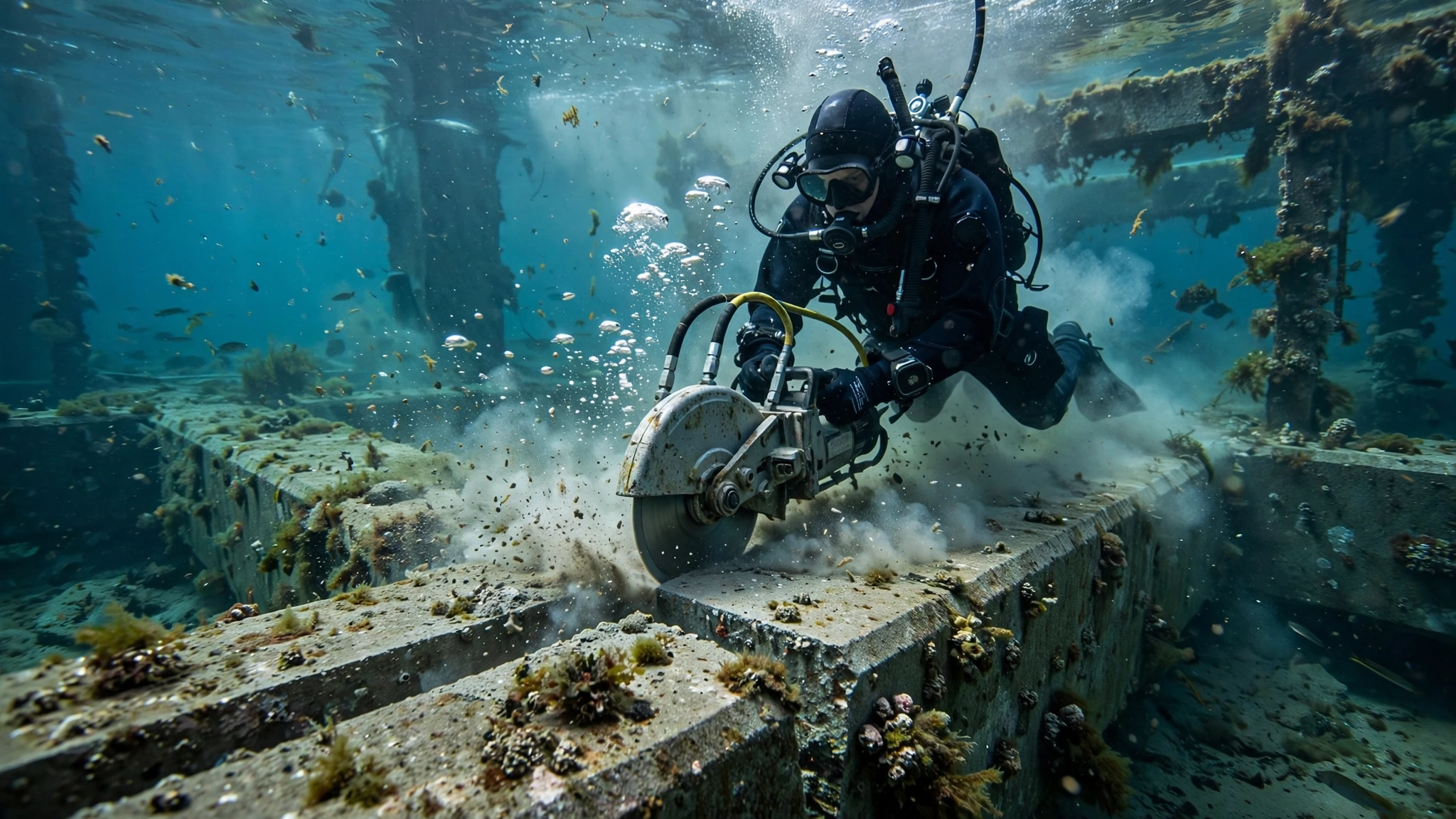
Underwater Concrete Cutting plays a vital role in marine construction, bridge repairs, dam maintenance, and offshore infrastructure projects. Safe cutting methods protect workers, preserve nearby structures, and reduce environmental impact. Modern equipment, trained diving teams, and strict safety procedures allow contractors to complete complex underwater tasks with precision. We will explain how the process works, which tools professionals use, and why safety remains the highest priority throughout every stage of an underwater concrete cutting project.
Marine engineers carefully plan every operation before any equipment enters the water. They inspect structural conditions, water depth, current strength, and visibility. This planning reduces unexpected hazards and ensures the cutting process meets engineering standards. Careful preparation also minimizes project delays and improves overall work quality.
Underwater Concrete Cutting is the controlled removal or modification of submerged concrete structures using specialized cutting systems. Contractors commonly perform this work on bridge foundations, ports, seawalls, tunnels, hydroelectric facilities, and offshore platforms. Unlike surface cutting, underwater operations require professional commercial divers, waterproof equipment, and detailed engineering plans.
The process focuses on accuracy rather than force. Engineers determine cutting depth, reinforcement locations, and structural loads before work begins. Professional crews also monitor water movement and visibility throughout the operation. These measures help maintain structural stability while protecting workers and nearby marine environments.
Modern underwater cutting depends on equipment specifically designed for submerged environments. Each tool serves a unique purpose based on project requirements and concrete thickness.
| Equipment | Primary Purpose | Safety Benefit |
|---|---|---|
| Diamond wire saw | Cuts reinforced concrete | Produces precise, controlled cuts |
| Hydraulic wall saw | Straight structural cutting | Reduces vibration |
| Hydraulic chain saw | Deep cutting sections | Improves cutting accuracy |
| Core drilling system | Circular openings | Protects surrounding structures |
| Remotely operated vehicle (ROV) | Inspection and monitoring | Reduces diver exposure |
Hydraulic systems remain popular because they operate safely underwater without electrical hazards. Diamond cutting technology also produces cleaner edges than traditional demolition methods. This precision lowers the chance of cracking adjacent concrete and reduces repair costs after project completion.
Every successful Underwater Concrete Cutting project begins with a detailed risk assessment. Engineers evaluate structural drawings, underwater conditions, and emergency response plans before approving work. Commercial diving supervisors also inspect communication systems and life-support equipment.
Key safety measures include:
Complete structural inspection before cutting.
Continuous communication between divers and surface crews.
Emergency rescue procedures ready before operations begin.
Water quality and visibility assessments.
Equipment testing before deployment.
Daily safety briefings for all personnel.
International commercial diving standards require certified divers to follow strict operational procedures. Regular inspections ensure cutting equipment performs reliably throughout the project. These preventive measures significantly reduce operational risks and improve project efficiency.
The cutting process follows a structured sequence to ensure safety and precision. Each phase receives approval before crews continue to the next stage.
The operation starts with underwater inspection and structural mapping. Engineers identify reinforcement bars, existing damage, and load-bearing sections. Divers then install guide systems that help maintain cutting accuracy. Proper alignment reduces unnecessary material removal and improves final structural quality.
Next, operators position hydraulic cutting equipment according to engineering specifications. The cutting system advances gradually while surface crews monitor pressure, cutting speed, and diver communication. Cooling water naturally removes dust during underwater operations, improving visibility around the cutting area. Engineers inspect each completed section before authorizing additional cuts. Explore our latest insights in What Is Wire Sawing?
Professional contractors recognize that Underwater Concrete Cutting affects both infrastructure and surrounding ecosystems. Environmental protection remains an important part of every project. Careful planning helps reduce sediment disturbance and protects aquatic habitats during construction activities.
Contractors often install containment barriers around cutting zones to limit debris movement. Waste materials are collected and removed instead of being allowed to spread through nearby waterways. Environmental monitoring teams also measure water quality throughout the project. These practices support regulatory compliance while reducing ecological impact on marine life.
Experienced contractors deliver safer and more reliable project outcomes than untrained crews. Certified commercial divers understand underwater hazards, specialized equipment, and emergency response procedures. Their expertise improves accuracy while reducing operational delays.
Professional services provide several important advantages:
Higher cutting precision.
Reduced structural vibration.
Faster project completion.
Lower environmental impact.
Improved worker safety.
Better long-term structural performance.
Industry studies from marine engineering organizations consistently show that diamond wire cutting creates less structural stress than impact demolition methods. Lower vibration preserves nearby concrete and reinforcement, extending the service life of repaired structures.
Underwater Concrete Cutting combines advanced engineering, specialized equipment, and highly trained professionals to deliver safe and accurate results. Careful planning, certified divers, and modern cutting technology reduce risks while protecting surrounding structures and marine environments. Following proven safety procedures ensures reliable project performance and long-term structural integrity.