
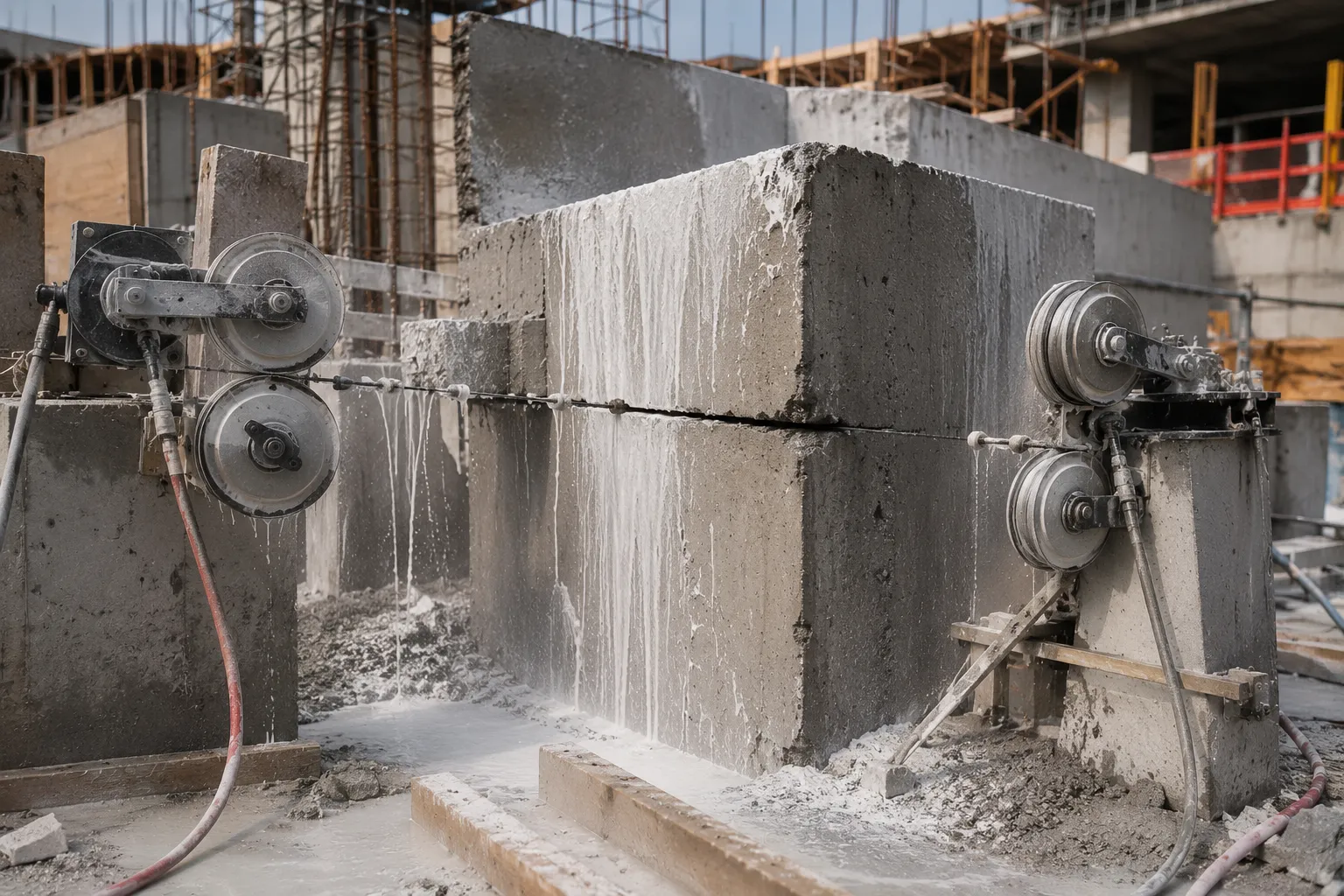
Wire sawing has become one of the most effective concrete cutting methods in modern construction and demolition projects. Unlike traditional cutting techniques, wire sawing uses a diamond-coated cable that continuously rotates around a structure to create precise cuts through concrete, reinforced concrete, steel, masonry, and stone. This advanced technology allows contractors to handle large-scale cutting tasks with greater efficiency and accuracy.
As construction projects become more complex, the demand for controlled and vibration-free cutting methods continues to increase. Wire sawing offers a practical solution for projects involving thick walls, bridge sections, foundations, and industrial structures. The method minimizes structural stress while maintaining exceptional cutting precision.
Many infrastructure, commercial, and industrial projects rely on wire sawing because it can cut materials of virtually any thickness. The technology also improves worker safety and reduces disruption on active job sites. Understanding how wire sawing works and where it delivers the most value helps project managers choose the right cutting method for challenging applications.
Wire sawing is a specialized cutting technique that uses a continuous steel cable embedded with industrial diamonds. The wire is threaded around the material and connected to a hydraulic or electric drive system. As the cable rotates at high speed, the diamonds grind through the material with remarkable precision.
The process typically operates at speeds between 65 and 82 feet per second. Water is continuously applied during cutting to cool the wire and control dust. This combination creates clean, accurate cuts while extending equipment life.
Unlike wall saws or slab saws, wire sawing does not have depth limitations. Contractors can cut concrete structures exceeding 10 feet in thickness without compromising accuracy. This capability makes the method particularly valuable for heavy civil engineering and infrastructure projects.
Key characteristics include:
Precise cutting of large structures.
Minimal vibration and noise.
Ability to cut irregular shapes.
Suitable for confined spaces.
Effective on heavily reinforced concrete.
One of the biggest advantages of wire sawing is its versatility. The technology can cut through reinforced concrete, structural steel, granite, brick, and other dense materials. This flexibility reduces the need for multiple cutting methods on a single project.
Another major benefit is structural protection. Traditional demolition methods often create vibrations that can damage surrounding areas. Wire sawing produces very little vibration, helping preserve nearby structures and critical infrastructure.
The method also improves job site efficiency. Large concrete sections can be removed in controlled pieces, reducing cleanup time and improving material handling. Faster project completion often translates into lower labor costs and reduced downtime.
Additional benefits include:
| Benefit | Project Advantage |
|---|---|
| Precision Cutting | Cleaner and more accurate cuts |
| Low Vibration | Reduced structural stress |
| Dust Control | Improved workplace safety |
| Deep Cutting Capacity | No practical thickness limits |
| Reduced Noise | Better for occupied environments |
| Versatility | Works on multiple materials |
These advantages explain why wire sawing remains a preferred solution for complex demolition and construction projects.
Wire sawing serves a wide range of industries and project types. Heavy infrastructure projects frequently use this method to remove bridge sections, piers, and large concrete foundations. The ability to make deep cuts without damaging adjacent structures is particularly valuable in these environments.
Commercial construction projects also benefit from wire sawing. Contractors use the technique when modifying existing buildings, creating openings for elevators, or removing structural walls. Precision cutting helps maintain building integrity during renovation work.
Industrial facilities often rely on wire sawing for equipment removal and plant upgrades. Manufacturing facilities, power plants, and refineries use the method because it minimizes disruption to ongoing operations.
Common applications include:
Bridge demolition projects.
Highway expansion work.
Nuclear facility decommissioning.
Dam and reservoir modifications.
Commercial building renovations.
Foundation and column removal.
Marine structure demolition.
The technology continues to expand into specialized sectors where accuracy and control are critical. Explore our solutions for Wire sawing.
Wire sawing provides significant project advantages beyond simple cutting performance. Safety improvements rank among the most important benefits. Controlled cutting reduces the risk of unexpected structural failure and allows contractors to remove materials systematically.
Environmental performance also improves with wire sawing. Water suppression systems significantly reduce airborne dust compared to impact demolition methods. Lower noise levels make the process suitable for hospitals, schools, and occupied commercial buildings.
From a project management perspective, wire sawing improves scheduling predictability. Contractors can accurately estimate cutting times and coordinate material removal more effectively. This level of control reduces delays and improves overall workflow.
Industry experts consistently highlight the method’s ability to handle challenging structural modifications without compromising safety or precision. For projects involving large reinforced concrete structures, wire sawing often provides the most reliable and cost-effective solution available.
Wire sawing has transformed how contractors approach concrete cutting and structural demolition. Its ability to deliver precise, vibration-free cuts through thick reinforced materials makes it an essential technology for modern construction projects. The method supports safer operations, cleaner job sites, and improved project efficiency.
Whether removing bridge sections, modifying commercial buildings, or handling industrial demolition, wire sawing offers unmatched flexibility and performance. As construction demands continue to evolve, this advanced cutting technique remains one of the most valuable solutions for complex structural challenges. Choosing wire sawing can help ensure greater accuracy, reduced disruption, and successful project outcomes.